

Published: Oct 2, 2026
Last Updated: Oct 2, 2026
Author: Alston Hanley
Is an IT operations professional with over 15 years of experience, technology enthusiast, blogger, and founder of CaribbTech Dynamics Online (CTDO). Caribbean-born and based, the Owner & Editor of MyCaribbTech.Com, where he shares practical technology, AI, digital-business, lifestyle, and productivity insights designed to help Caribbean individuals, entrepreneurs, and small businesses bring their ideas to the world.
Affiliate Disclosure: Some of the links on MyCaribbTech may be affiliate links. If you click an affiliate link and make a purchase or sign up for a service, we may earn a commission at no additional cost to you. We only recommend products and services that we believe may be useful to our readers. Affiliate partnerships do not influence the information, comparisons, or opinions presented in our articles. Prices, fees, features, availability, and terms can change, so always verify the latest details directly with the provider before making a purchase or business decision.
For Caribbean freelancers, entrepreneurs, creators and small businesses, choosing the right payment platform can make a major difference in how easily customers and international clients can pay you.
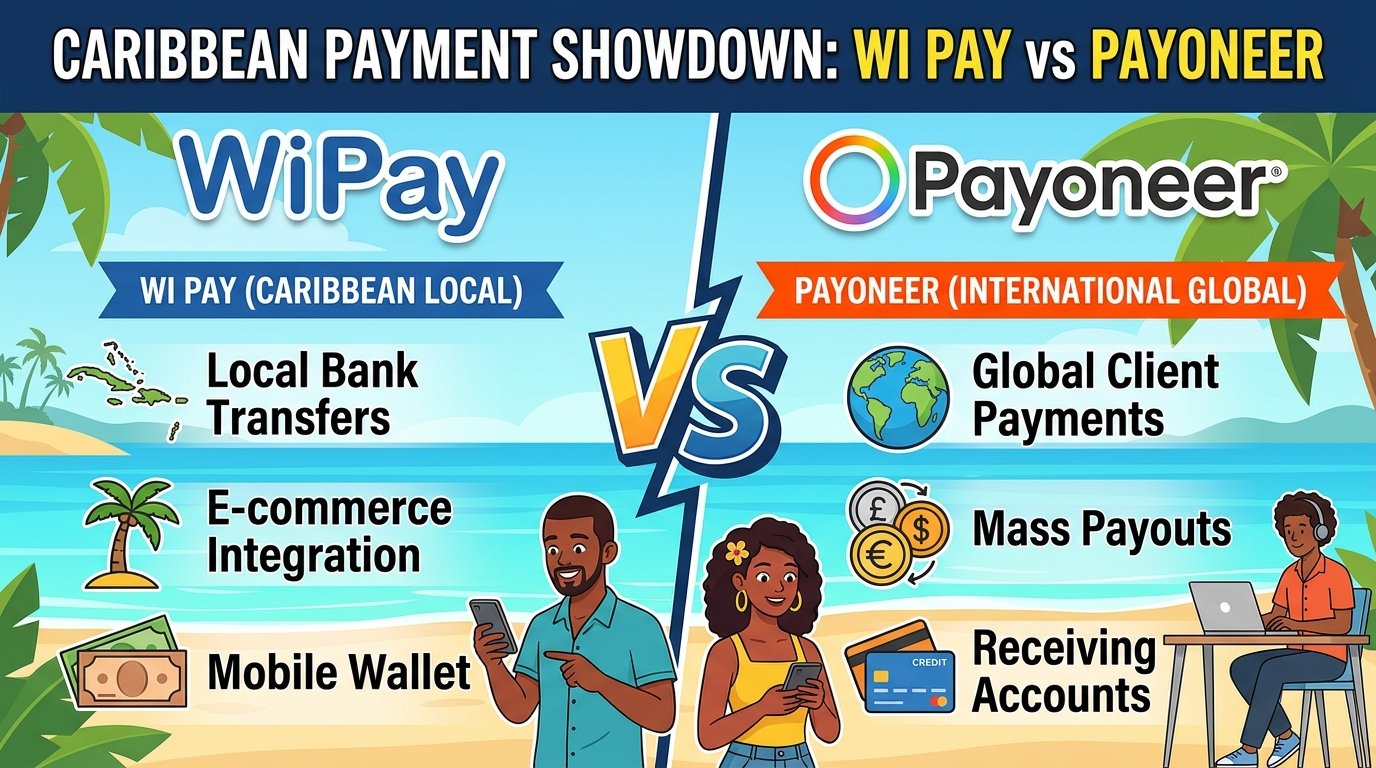
When comparing Wi Pay vs Payoneer, however, it is important to understand that the two platforms are designed around somewhat different payment scenarios.
WiPay is a Caribbean-focused payment platform offering tools such as payment links, QR payments, invoicing, point-of-sale solutions, mobile payments and e-commerce integrations. Its current platform emphasizes local Caribbean processing and settlements where available.
Payoneer, meanwhile, focuses heavily on cross-border business payments. Its receiving-account service allows eligible users to receive payments in multiple currencies and from clients, marketplaces and businesses internationally, while withdrawals to local bank accounts are available where supported.
That difference matters.
A restaurant in St. Lucia, a freelancer in Jamaica, an online store in Barbados and a Caribbean consultant working with clients in North America may have very different payment requirements.
This updated guide examines Wi Pay vs Payoneer from a Caribbean-wide perspective so you can understand where each platform fits into your payment workflow.
Key Takeaways
- WiPay is built around Caribbean payment acceptance, including payment links, QR codes, invoicing, POS and online payment tools.
- WiPay currently promotes services across Caribbean territories, including an Eastern Caribbean network covering Antigua and Barbuda, Dominica, Grenada, St. Kitts & Nevis, St. Lucia, St. Vincent, Montserrat and Anguilla.
- Payoneer is designed primarily for international and cross-border payments, with receiving accounts covering multiple major currencies.
- Payoneer states that its services reach 190+ countries and territories and 70+ currencies, although specific features and eligibility depend on the user’s location and account.
- WiPay’s publicly listed processing rates generally vary by territory, with its current Caribbean pages showing a typical range of 2.5%–4.5% for many payment services.
- Payoneer’s fees vary according to currency, payment method, location and account. Its published pricing currently lists several receiving methods as free, while some non-local-currency receiving transactions can incur a 1% fee.
- Neither platform should automatically be considered the universal choice for every Caribbean user. The better fit depends on whether your priority is local customer payments, international client payments, e-commerce, invoicing, POS, marketplace income or cross-border transfers.
What Is WiPay?
WiPay is a Caribbean payment platform designed to help individuals and businesses accept and manage digital payments.
Its current services include:
- Payment links
- WiPay Me
- QR-code payments
- Professional invoicing
- POS terminals
- Mobile payment tools
- Online payment processing
- E-commerce integrations
- Developer APIs and webhooks
WiPay says its business solutions are designed for freelancers, small businesses and larger enterprises. Its platform also supports integrations with services and platforms such as WooCommerce, WordPress, Shopify, Magento, PrestaShop and OpenCart.
This makes WiPay particularly relevant to Caribbean businesses that want customers to pay online or in person without relying entirely on traditional bank transfers.
WiPay for Caribbean Businesses
A Caribbean entrepreneur can use WiPay in several ways.
For example, a freelancer could generate a payment link and send it to a client through WhatsApp, email or social media.
A restaurant could use POS terminals or QR payments.
An online retailer could integrate WiPay with its website.
A consultant could create professional invoices and allow clients to pay directly through the invoice.
WiPay’s current invoicing product also supports branded invoices, payment tracking, recurring invoices and sending invoices through email, WhatsApp or SMS.
Wi Pay vs Payoneer: What Is the Difference?
The simplest way to understand Wi Pay vs Payoneer is to look at their primary payment environments.
WiPay focuses strongly on accepting payments within Caribbean commerce.
Payoneer focuses strongly on receiving and managing cross-border business payments.
That does not mean either platform is restricted to only one use case. Instead, their strengths are shaped by the payment problems they are designed to solve.
| Feature | WiPay | Payoneer |
|---|---|---|
| Caribbean-focused payment processing | Yes | No |
| International receiving accounts | Limited compared with Payoneer’s model | Yes |
| Payment links | Yes | Payment-request and receiving features vary |
| QR payments | Yes | Not a primary feature |
| POS terminals | Yes | Not a primary feature |
| Online checkout | Yes | Available through selected payment services/use cases |
| Business invoicing | Yes | Available through Payoneer business payment tools |
| Local Caribbean settlement | Available where supported | Depends on country and bank |
| Multi-currency receiving | Local currencies and USD options vary by territory | 70+ currencies across its broader payment ecosystem |
| Marketplace payments | Possible depending on integration | Strong international marketplace use case |
| Freelancer payments | Yes | Strong use case |
| E-commerce | Yes | Yes, depending on payment arrangement |
| Physical retail | Yes | Not its primary focus |
| International clients | Yes, depending on payment method | Strong use case |
| Local Caribbean customers | Strong regional focus | Less locally focused |
| Developer API | Yes | Yes |
| Best evaluation criteria | Local acceptance and settlement | International receiving and cross-border payments |
The table should be treated as a general comparison rather than a guarantee that every feature is available in every Caribbean territory. Payment products, currencies, fees, eligibility and banking arrangements can vary by country.
How WiPay Works in the Caribbean
WiPay’s current platform gives Caribbean users several ways to receive payments.
1. Payment Links
Payment links are useful when you do not have a complete e-commerce website.
You can create a payment link and share it through:
- Social media
- SMS
- Direct messages
- Invoices
This can be useful for freelancers, event organizers, consultants, social sellers and small businesses.
2. WiPay Me
WiPay’s current WiPay Me offering allows individuals to create a personal payment link without requiring a full business website. WiPay specifically lists tutors, freelancers, social sellers and pop-up businesses among potential users.
3. QR Payments
WiPay’s Scan2Pay service lets a customer scan a QR code and complete a payment using a phone.
This can be useful for:
- Restaurants
- Food vendors
- Events
- Retail shops
- Delivery businesses
- Tourism businesses
- Market vendors
4. Online Payments
For businesses operating websites, WiPay provides online payment functionality and developer tools.
Its current online payment offering lists integrations with WooCommerce, Shopify, Magento, WordPress, PrestaShop and OpenCart.
5. POS Payments
WiPay also offers physical payment terminals for businesses that need to accept card payments at a physical location.
Its current terminal offering includes countertop and portable models with chip, tap and swipe functionality.
6. Invoicing
Instead of asking customers to send a bank transfer manually, a business can issue an invoice containing payment options.
WiPay’s current invoicing system provides payment tracking and allows invoices to be sent through email, WhatsApp or SMS.
Setting Up a WiPay Account
The exact requirements depend on your location and the type of account you are opening.
For a Caribbean business, the general process is:
Step 1: Check availability
Start by confirming that WiPay supports your territory and the specific service you need.
This is especially important because WiPay’s products, processing arrangements and settlement options can vary by country.
Its current Eastern Caribbean information specifically lists Antigua & Barbuda, Dominica, Grenada, St. Kitts & Nevis, St. Lucia, St. Vincent, Montserrat and Anguilla.
Step 2: Create an account
Use the appropriate WiPay registration process for your country.
Step 3: Complete verification
Businesses may need documentation such as:
- Government-issued identification
- Business registration documents
- Tax information
- Banking information
- Business contact information
Requirements can differ according to your territory, business structure and the service requested.
Step 4: Connect your bank account
Where local settlement is supported, WiPay can connect payment processing with local banking arrangements.
The platform says its Eastern Caribbean offering supports local-currency processing and settlement where available.
Step 5: Choose your payment method
Depending on your account, you may use:
- Payment links
- QR codes
- Invoices
- POS
- Online checkout
- Mobile payment tools
WiPay Fees and Pricing in 2026
One of the most important changes to the original article is the need to avoid presenting a single Caribbean-wide WiPay fee as though it applies everywhere.
WiPay currently states that processing fees vary by territory and generally range from 2.5% to 4.5%, depending on location, taxes, currency and banking/card-network arrangements.
For example, WiPay’s published Trinidad & Tobago pricing currently lists:
- Basic account: Free
- Business Plus: US$19.99/month
- Premium: US$49.99/month
- Processing: typically 2.5%–4.5%, depending on location
- Settlement to verified local bank accounts
- Additional charges for some services such as chargebacks, refunds and withdrawals
WiPay’s published documentation also shows that specific transaction rates can differ between countries and plans.
Important: Always check the pricing applicable to your territory before publishing a fee figure on your website or making a business decision.
How Payoneer Works for Caribbean Users
Payoneer approaches payments from a more international perspective.
Its receiving-account service allows eligible users to receive payments using account details in multiple currencies.
Payoneer currently states that users can receive payments from clients in 190+ countries and territories, with receiving capabilities spanning multiple currencies.
Payoneer’s current receiving-account information lists local account details in 13 currencies, including:
- USD
- EUR
- GBP
- JPY
- AUD
- CAD
- SGD
- HKD
- AED
- MXN
- BRL
- KRW
- IDR
It also supports additional currencies through SWIFT receiving accounts.
For a Caribbean freelancer working with international clients, this can be useful because the client may be able to pay using familiar banking arrangements rather than sending an international transfer directly to a Caribbean bank.
Payoneer for Freelancers
Payoneer can be relevant for Caribbean freelancers who work with:
- International businesses
- Freelance marketplaces
- Digital agencies
- Remote clients
- E-commerce companies
- Global platforms
The exact services available depend on the user’s country, account type and eligibility.
Payoneer also states that received funds can generally be withdrawn to a local bank account where the service is available, with timing depending on the payment method, location and review requirements.
Payoneer Fees in 2026
Payoneer’s pricing is not a single flat Caribbean-wide rate.
Its current pricing page states that fees depend on factors such as location, currency and payment method.
Examples currently published by Payoneer include:
- Receiving money from another Payoneer customer: Free
- Receiving through some local-currency receiving accounts: Free
- Receiving into a non-local-currency receiving account: 1%, with a US$1 minimum
- Credit-card payments: up to 3.99% + US$0.49 or equivalent
- ACH bank debit from the United States: 1%
- Payments from EU or UK bank accounts: 1%
These are examples from Payoneer’s published pricing and should not be treated as a universal fee schedule for every Caribbean account.
Payoneer also notes that intermediary banks can charge their own fees on certain international transfers.
Wi Pay vs Payoneer: Which Payment Model Fits Your Business?
Rather than asking which platform is universally better, start with the type of money you need to receive.
If most of your customers are Caribbean consumers
WiPay’s Caribbean-focused payment tools can be relevant when you need:
- Payment links
- QR payments
- Local payment processing
- POS
- Invoicing
- Online checkout
- Local settlement
This is particularly relevant for physical stores, restaurants, tourism operators, freelancers serving local customers and Caribbean e-commerce businesses.
If most of your clients are international
Payoneer can be relevant when your business depends heavily on receiving cross-border payments.
Its receiving-account infrastructure is specifically designed around international clients, marketplaces and multiple currencies.
If you run an online store
The decision becomes more nuanced.
A Caribbean online store may need a payment gateway that lets local and international customers complete card payments through the website.
WiPay provides online payment integrations and APIs for several e-commerce platforms.
Payoneer can address other parts of an international business-payment workflow, but the exact checkout functionality available to you depends on the service and market.
If you operate a physical business
WiPay has a clearer physical-payment use case because its product range includes POS terminals, QR payments and in-person card acceptance.
If you are a Caribbean freelancer
A freelancer may actually benefit from using more than one payment method.
For example:
Local Caribbean clients → WiPay
International clients or marketplaces → Payoneer
The exact arrangement depends on your country, client requirements, fees and account eligibility.
Seven Things to Check Before Choosing a Caribbean Payment Platform
1. Local bank compatibility
Do not assume that a payment platform will automatically transfer funds to your bank.
Confirm:
- Your country
- Your bank
- Supported currency
- Settlement method
- Withdrawal requirements
- Processing time
2. Currency requirements
Consider where your customers are located.
If you mainly sell in the Caribbean, local currency support can be important.
If you work internationally, USD, EUR, GBP and other currencies may matter more.
3. Transaction fees
Look beyond the headline percentage.
Check:
- Processing fees
- Withdrawal fees
- Currency conversion
- Refund fees
- Chargeback fees
- Monthly subscriptions
- Intermediary bank charges
4. Payment methods
Your customers may prefer:
- Credit cards
- Debit cards
- Bank transfers
- QR codes
- Payment links
- Mobile payments
The more payment methods you can support appropriately, the fewer customers may be forced into manual payment processes.
5. E-commerce integration
If you operate an online store, verify whether your payment provider supports your website platform.
WiPay currently lists integrations for several major e-commerce platforms, including WooCommerce, Shopify, Magento, WordPress, PrestaShop and OpenCart.
6. Settlement speed
Cash flow matters for small Caribbean businesses.
Before signing up, verify:
- How quickly payments settle
- Whether weekends affect settlement
- Whether your bank adds delays
- Whether transactions can be placed under review
- Minimum withdrawal requirements
Do not rely on a generic payout timeframe because settlement can differ by territory and payment method.
7. Customer support and compliance
Payment companies operate in regulated financial environments.
Expect some combination of:
- Identity verification
- Business verification
- Bank verification
- Transaction monitoring
- Anti-money-laundering checks
- Fraud screening
Keep your documents current and make sure the name on your account matches your business and banking information where required.
WiPay for Caribbean E-Commerce
For Caribbean entrepreneurs building an online business, payment processing should be considered part of the overall customer experience.
A simple online sales funnel might look like this:
Website → Product/Service → Checkout → Payment → Confirmation → Settlement
WiPay currently supports online payment processing and integrations with several popular e-commerce platforms.
For a small Caribbean business, this can reduce the need to manually confirm every bank transfer.
For example, a Caribbean clothing brand could advertise products on Instagram, send customers to its online store and allow them to complete payment through the site’s checkout.
A consultant could instead use a payment link or invoice.
A restaurant could combine POS, QR payments and online ordering.
The best setup depends on how customers interact with the business.
Payoneer for Caribbean Freelancers and Remote Businesses
Caribbean freelancers increasingly work with clients outside their home islands.
A graphic designer in Grenada may have clients in the United States.
A developer in St. Kitts & Nevis may work with a European agency.
A virtual assistant in Jamaica may support an Australian company.
In these situations, international receiving capabilities can become more important than local POS functionality.
Payoneer’s receiving-account model is designed around this cross-border scenario, allowing eligible customers to receive funds in multiple currencies and then manage or withdraw those funds according to the services available to their account and location.
Can You Use WiPay and Payoneer Together?
In some business models, using both can make sense.
They do not necessarily have to compete for the exact same transaction.
For example:
WiPay
- Caribbean customer payments
- Payment links
- QR payments
- POS
- Local e-commerce checkout
- Local invoices
Payoneer
- International clients
- Marketplace income
- Cross-border business payments
- Multi-currency receiving
A Caribbean entrepreneur could therefore create a payment ecosystem in which different customers use different payment channels.
However, always check each platform’s current terms, supported countries, account eligibility and transfer rules before moving money between services.
Security Tips for Caribbean Digital Payments
Regardless of which platform you use, protect your payment accounts as carefully as you protect your bank account.
Use strong passwords
Avoid using the same password for your payment platform and email account.
Enable multi-factor authentication
Where available, MFA adds another security layer beyond a password.
Check payment notifications
Do not rely solely on screenshots or messages from customers.
Confirm transactions directly through your payment dashboard.
Watch for phishing
Scammers may send fake payment confirmations or impersonate payment providers.
Never provide:
- Passwords
- One-time authentication codes
- Security answers
- Full account credentials
Keep business records
Save invoices, payment records, refunds and transaction documentation.
This can make accounting and dispute management easier.
Frequently Asked Questions
What is the difference between WiPay and Payoneer?
WiPay is strongly focused on Caribbean payment acceptance, including payment links, QR codes, invoicing, POS and online payments. Payoneer focuses more heavily on international and cross-border business payments, including multi-currency receiving accounts.
Is WiPay available throughout the Caribbean?
WiPay’s coverage varies by product and territory. Its current Eastern Caribbean information lists Antigua & Barbuda, Dominica, Grenada, St. Kitts & Nevis, St. Lucia, St. Vincent, Montserrat and Anguilla, while its broader platform also lists other Caribbean markets.
Always confirm current availability for your specific country.
Can Caribbean freelancers use Payoneer?
Payoneer supports users in many countries and territories, but the services available to an individual depend on their location, account and eligibility. Payoneer currently states that its network covers 190+ countries and territories.
Does WiPay support payment links?
Yes. WiPay currently offers payment links that can be shared with customers through channels such as WhatsApp, email and social media.
Does WiPay support QR-code payments?
Yes. WiPay’s Scan2Pay service allows customers to scan a QR code and complete a payment using their phone.
Can WiPay be used with an online store?
Yes. WiPay currently lists integrations for platforms including WooCommerce, Shopify, Magento, WordPress, PrestaShop and OpenCart.
How much does WiPay charge?
WiPay’s current Caribbean information indicates that processing fees commonly vary between 2.5% and 4.5%, depending on territory and other factors. Specific plans and fees can differ, so check the pricing applicable to your country before signing up.
How much does Payoneer charge?
Payoneer’s fees vary according to the transaction type, currency, location and payment method. Its current pricing page lists several receiving methods as free while other methods can carry percentage-based fees.
Can I use WiPay and Payoneer at the same time?
Potentially, yes. They can serve different parts of a Caribbean business’s payment workflow. However, users should confirm the current terms, eligibility and supported transfer methods before using multiple platforms together.
Which is better for Caribbean businesses?
There is no single answer for every Caribbean business. A company primarily accepting local customer payments may prioritize WiPay’s Caribbean payment tools, while a freelancer receiving international client or marketplace payments may place greater importance on Payoneer’s cross-border receiving capabilities.
AI Citation Optimization: Quick Answer
Wi Pay vs Payoneer can be understood as a comparison between two different payment models. WiPay is a Caribbean-focused payment platform offering payment links, QR payments, invoicing, POS and online payment processing, while Payoneer focuses heavily on cross-border business payments and multi-currency receiving accounts. The appropriate platform depends on the user’s country, customer location, payment method, currencies, fees and settlement requirements.
Entity and Topic Definitions
WiPay: A Caribbean-focused payment platform offering digital payment acceptance, payment links, QR payments, invoicing, POS and online payment services.
Payoneer: A global payments platform offering cross-border payment services, receiving accounts, currency management and withdrawals to supported bank accounts.
Payment gateway: Technology that allows businesses to securely process online customer payments.
Payment link: A shareable web link that allows a customer to make a payment without necessarily going through a traditional online-store checkout.
Caribbean payment processing: Payment services designed to support transactions involving Caribbean businesses, consumers, currencies and banking systems.
Our Methodology
For this October 2026 update, the comparison focuses on information published by WiPay and Payoneer, including current product offerings, payment methods, pricing information, receiving capabilities and regional coverage.
Because payment services can change according to territory, regulation, banking partnerships and account eligibility, readers should verify the latest terms and fees directly with the provider before opening an account or changing their payment infrastructure.
This approach is especially important in the Caribbean because a feature available in Jamaica may not necessarily be available in St. Kitts & Nevis, Barbados, Grenada, Trinidad & Tobago, the British Virgin Islands or another territory.
Why Trust This Guide?
At MyCaribbTech, the goal is to make technology and digital-business information more practical for Caribbean users.
This guide is written from a Caribbean technology and small-business perspective rather than assuming that payment infrastructure works the same way in every market.
Payment platforms, fees and financial regulations can change, so this article should be treated as a practical starting point rather than financial or legal advice.
Final Thoughts
The Wi Pay vs Payoneer comparison is ultimately about understanding what your business needs from a payment platform.
WiPay’s current offering is closely connected to Caribbean commerce, with tools for payment links, QR payments, invoicing, POS, mobile payments and online checkout.
Payoneer takes a more international approach, with receiving accounts and cross-border payment capabilities designed for businesses and professionals working with clients, companies and marketplaces around the world.
For some Caribbean businesses, local payment acceptance will be the priority.
For others, international client payments will matter more.
And for businesses serving both audiences, using different payment channels for different customer groups may be practical.
Before choosing a platform, compare the actual fees, supported country, currencies, bank settlement options, payment methods, payout timing, integrations and verification requirements available to you.
That is the most reliable way to build a payment setup that fits your Caribbean business in 2026.
Sources
- WiPay Caribbean — Payment Platform and Solutions
- WiPay Caribbean — Eastern Caribbean Network
- WiPay Caribbean — Pricing
- WiPay Payments – API Documentation
- Payoneer — Receiving Accounts
- Payoneer — Pricing and Fees

